Skip Navigation
A-Z Topics · Directory
  Print Page

Adrenal Gland Disorders: Condition Information

What are adrenal gland disorders?

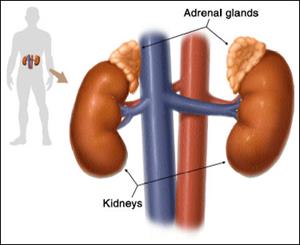
The adrenal glands are small glands located on top of each kidney. The outer part of the gland, called the adrenal cortex, produces hormones that are necessary for life. The two main hormones produced are cortisol (pronounced KAWR-tuh-sohl) and aldosterone (pronounced al-DOS-tuh-rohn). Cortisol and aldosterone are classified as steroid hormones. Cortisol helps the body respond to stress and helps to regulate blood pressure and blood sugar levels. It is also important in the metabolism of fats, proteins, and carbohydrates. Aldosterone also contributes to blood pressure control and helps to manage the amount of salt and potassium in the body.1

The inner part of the gland, called the adrenal medulla (pronounced muh-DUHL-uh), produces the hormones adrenaline and noradrenaline, which are very important in controlling the body’s reaction to stress.

Adrenal gland disorders occur when the adrenal glands do not work properly. They can be classified into disorders where too much hormone is produced or where too little hormone is produced. These disorders can occur when the adrenal gland itself is affected by a disease process due to genetic mutation, tumors, or infections. Or, sometimes the cause is a problem in another gland, such as the pituitary, which helps to regulate the adrenal gland. In addition, some medications can cause the adrenal gland not to function properly. When the adrenal glands produce too few or too many hormones, or when too many hormones are introduced by an outside source, significant disorders can develop.2

Adrenal Gland Disorders

Adrenal Gland Tumors

Most adrenal gland tumors are noncancerous. They often do not cause symptoms or require treatment. However, adrenal gland tumors can produce and thus cause excess levels of a variety of different hormones.

Adrenal tumors can cause:

  • Cushing’s syndrome by producing and thus raising body levels of cortisol
  • Primary hyperaldosteronismby, creating excess levels of aldosterone
  • Pheochromocytoma by producing too much adrenaline

Adrenocortical Carcinoma

This is a cancerous adrenal tumor that tends to develop in the outer layer of the adrenal gland. Cancerous adrenal tumors are often found years after they start growing, at which point they typically have spread to other organs.

Cushing’s Syndrome

Cushing’s syndrome is a rare disease that results from having too much cortisol hormone in the body. In some cases, Cushing’s syndrome develops from prolonged or excess use of steroid medications. In other cases, the body itself produces too much cortisol. This can happen for several reasons, including the presence of tumors (abnormal growths) such as:

  • A tumor of the pituitary gland
  • A tumor of the adrenal gland
  • A tumor in another part of the body (these are called "ectopic" tumors and are more commonly found in the pancreas, lung, or the thyroid gland)

Congenital Adrenal Hyperplasia (CAH)

CAH is a common genetic disorder that prevents the body from making enough cortisol. People with CAH sometimes also have other hormone imbalances. For example, their bodies might not make enough aldosterone but might make too much androgen. Aldosterone is a hormone that controls blood pressure as well as the amount of salt and potassium in the body. Androgen hormones promote the development of male sexual organs.

Pituitary Tumors

The pituitary gland is located at the base of the brain. It releases hormones that affect many of the body’s functions. Among those hormones is the adrenocorticotropic (pronounced a-DREE-noh kawr-tuh-koh-TRO-pic) hormone (ACTH), which stimulates the adrenal glands to release the hormone cortisol. Sometimes, benign (noncancerous) tumors or—more rarely cancerous tumors3—may grow on the pituitary gland, which can cause a variety of problems. Some pituitary tumors release too much ACTH, which, in turn, can cause the adrenal glands to produce too much cortisol. This reaction can lead to a type of Cushing’s syndrome known as Cushing’s disease.

Pheochromoctyoma

Pheochromocytomas are part of a larger family of tumors called paragangliomas. Pheochromoctyoma is a paraganglioma that develops in the adrenal medulla. It produces adrenaline, causing excess levels of this hormone in the body. In most cases, the tumors are not cancerous and do not spread to other parts of the body. In about 10% of cases, the tumors are cancerous.

Adrenal Gland Suppression

The normal activity of the adrenal glands can be suppressed when people take steroid medications (medicines that act like cortisol in the body) such as prednisone, hydrocortisone, or dexamethasone.4 Steroid medications, most often prednisone, may be prescribed to treat certain types of arthritis, severe allergic reactions, autoimmune (pronounced awh-toh-im-YOON) diseases, and other conditions.5 Ordinarily, the dose of steroids is tapered slowly before the drug is stopped completely. When steroid medications are stopped suddenly, after being taken for several weeks or more, the adrenal glands may be unable to produce steroid hormones (most importantly, cortisol) in sufficient amounts for several weeks or even months.3

Addison’s Disease

This rare disorder develops when the adrenal glands do not make enough cortisol. In most cases of Addison’s disease, the body also fails to make enough of the hormone aldosterone. Addison’s is an autoimmune disease—a condition in which the immune system mistakenly attacks the body’s own tissues and cells. In the case of Addison’s disease, this reaction results in damage to the adrenal glands.6

Hyperaldosteronism

This is a disorder in which the body produces too much aldosterone. The excess aldosterone is either produced by an adrenal gland tumor that typically affects one adrenal gland or from abnormal growth of both glands, called "adrenal hyperplasia."


  1. EndocrineWeb. (2012). An overview of the adrenal glands: Beyond fight or flight. Retrieved June 29, 2012 from http://www.endocrineweb.com/endocrinology/overview-adrenal-glands [top]
  2. American Urological Association Foundation. (2011). Adrenal gland disorders. Retrieved June 4, 2012, from http://www.urologyhealth.org/urology/index.cfm?article=89 [top]
  3. American Society of Clinical Oncology. (2012). Pituitary gland tumor. Retrieved June 29, 2012, from http://www.cancer.net/patient/Cancer+Types/Pituitary+Gland+Tumor [top]
  4. National Library of Medicine. (June 2012). Cushing syndrome. Retrieved July 27, 2012, from http://www.nlm.nih.gov/medlineplus/ency/article/000410.htm [top]
  5. National Library of Medicine. (2011). Prednisone. Retrieved on July 27, 2012, from http://www.ncbi.nlm.nih.gov/pubmedhealth/PMH0000091 [top]
  6. National Library of Medicine. (2012). Addison’s disease. Retrieved June 29, 2012, from http://www.nlm.nih.gov/medlineplus/addisonsdisease.html [top]

Last Updated Date: 11/30/2012
Last Reviewed Date: 11/30/2012
Vision National Institutes of Health Home BOND National Institues of Health Home Home Storz Lab: Section on Environmental Gene Regulation Home Machner Lab: Unit on Microbial Pathogenesis Home Division of Epidemiology Statistics and Prevention Branch Home Bonifacino Lab: Section on Intracellular Protein Trafficking Home Lilly Lab: Section on Gamete Development Home Lippincott-Schwartz Lab: Section on Organelle Biology